SMART CITIES
Passenger information, outside the vehicle.
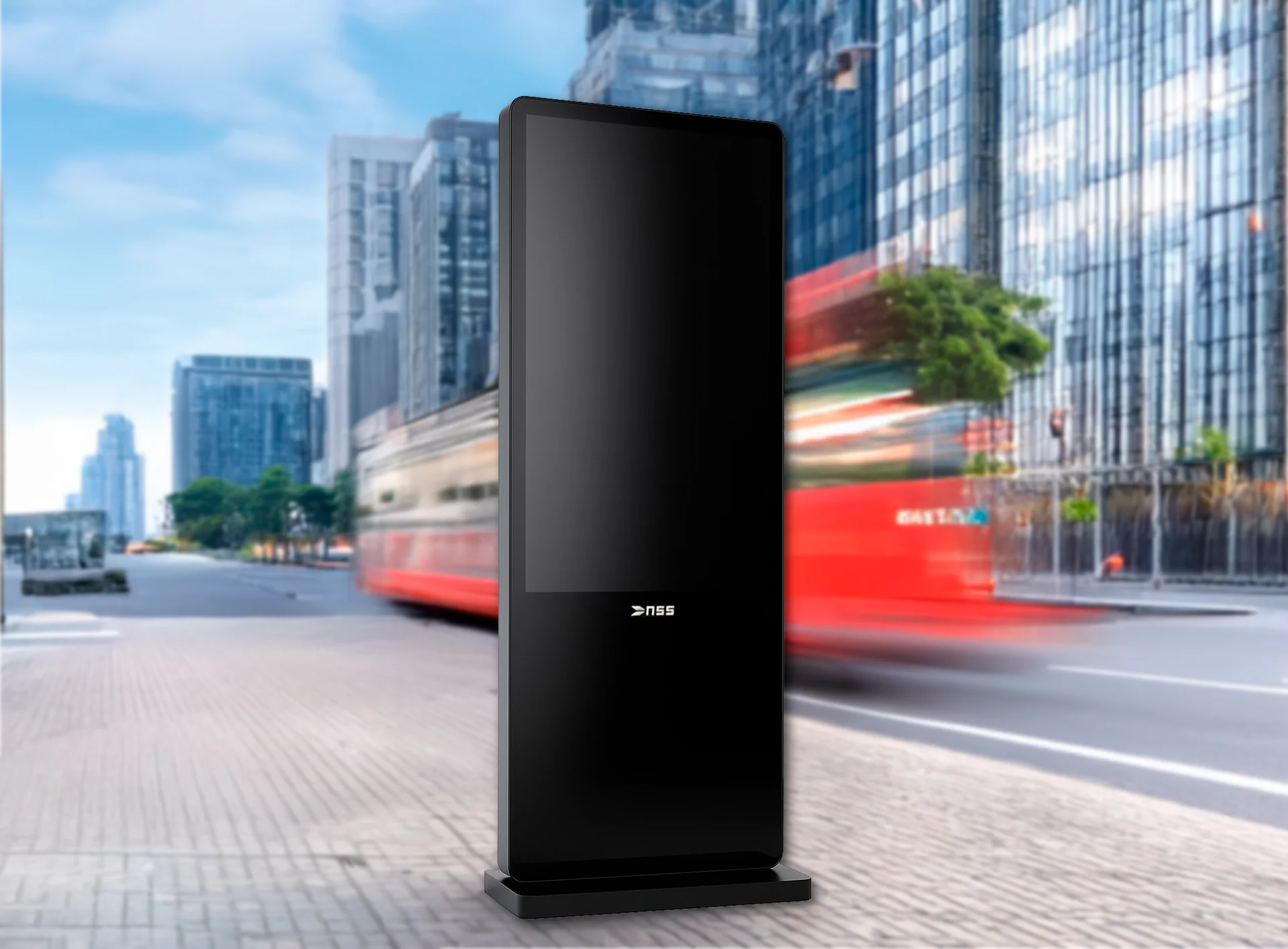
The same principle as the on-board panels, taken out onto the street: the INSAT Station totem where passengers wait, and the central control room on the ground deciding what appears on it.
A bus stop has three layers.
The physical place where the passenger waits — the shelter. What is there to inform them — the totem. And the ground-side system that decides what appears on the screen and checks that it is working — the central control room.
Of these three, NSS manufactures the totem. The central control room is NSS software, also available in a municipal configuration.
INSAT STATION
The totem is the INSAT Station in its vertical version.
INSAT Station is a passenger infotainment system for direct communication with passengers, in indoor and outdoor environments. In its vertical version, standing on its own base, it is the totem — the equipment NSS takes to stations, terminals, interchanges and bus stops.
Where the site already has a structure of its own, the same screen is also available as a monitor for integration into that structure.
What the passenger sees
Journey information
Stop name and code, lines and destinations, real-time arrival times, a map with the real-time location of vehicles, and local date and time.

Alerts and messages
Immediate updates, service changes, news and contextual content, and communication in emergency situations.

Multimedia playback
Video and images managed remotely, with scheduling and geofencing of content, institutional and promotional campaigns, tourism promotion and advertising revenue.

Audio announcements
Announcements with no need for prior recording, with multi-language support. Available as an add-on module.

Air quality
Temperature, relative humidity, PM2.5 and PM10 particulates, volatile organic compounds TVOC, nitrogen oxides NOx, carbon monoxide CO and carbon dioxide CO2. Available as an add-on module.

Branding and accessibility
Layout fully customisable to the brand's identity, inclusive design with colours and layouts adapted for colour blindness, and day/night modes for reading in any light condition.
AIR QUALITY
The totem can also tell you what you're breathing.
As an add-on module, the INSAT Station measures temperature, relative humidity, PM2.5 and PM10 particulates, volatile organic compounds TVOC, nitrogen oxides NOx, carbon monoxide CO and carbon dioxide CO2, and shows the values on the screen itself in real time.

CONCEPT — illustration of the function, not a real capture of the system. Illustrative values.
Built to stand on the street.
The totem lives exposed to sun, rain and whatever the street does to it. The INSAT Station datasheet answers that in the enclosure, the cooling and the screen brightness.
Display
Brightness adjustable up to 5000 nits. Day/night viewing modes, manual or automatic.

Enclosure and safety
6 mm tempered glass with IK10 protection. Customisable, robust and anti-corrosion enclosure. IP65 protection against water, dust and external agents. Intelligent cooling by ventilation or integrated air conditioning.

System and performance
AC 208–240 V power supply. USB, HDMI, RJ45 ports and SD slot. Android or Linux operating system. 4 GB RAM and 32 GB storage.
Add-on modules
4G router module
Air quality monitoring module
Audio announcement module
The same family as the on-board panels.
INSAT Station content is managed remotely. The on-board range — formats, datasheets and management portal — is on the INSAT page.
CENTRAL CONTROL ROOM
What feeds the city's screens.
PCC is the ground-side platform where a transit operation is planned, monitored and regulated. It is designed to be used in a municipal configuration as well, by those who manage the network on the authority's side rather than the operator's — and it is from here that the information reaching the screens in public space comes, and back to here that the status of each device returns.